[shared_counts]
Best Trailers for Landscaping: Choosing the Right Type, Size, and Setup for Your Business
When choosing a landscaping trailer, a single parameter is not what matters most; it is how they combine with one another. You need to determine the main cargo type, its weight, equipment volume, and loading method. For a trailer for landscaping, the allowable trailer payload and the vehicle’s towing capacity are checked separately.
After that, the choice becomes much simpler. An open platform is convenient for equipment that is frequently loaded and unloaded; an enclosed body works when equipment needs protection; and a dump trailer is best when the primary work involves bulk materials and waste.
Quick Decision Matrix:
- Lawn mowers, trimmers, and leaf blowers → Open Utility Trailer — fast loading and easy access to equipment.
- Expensive power equipment → Enclosed Cargo Trailer — weather protection and lockability.
- Soil, mulch, gravel, sod, and yard waste → Dump Trailer — more convenient for unloading heavy materials.
- Small crew → 6×10 or 6×12 — compact size for a basic equipment set.
- Multiple lawn mowers and extra equipment → 7×14 or 7×16 tandem axle — more space for machinery and gear.
Step 1: Matching the Trailer Type to Your Landscaping Services
The trailer type should be determined by the nature of the load, not by its appearance. A lawn mower needs to be loaded quickly and unloaded just as fast. Power tools sometimes need to be left inside between job sites. Soil or mulch, on the other hand, needs less to be stored and more to be transported and dumped without unnecessary manual labor.
Open Utility Trailers: The Classic Open Landscape Trailer Setup
An open trailer is convenient for a workday when machinery must be retrieved often. A riding lawn mower can be loaded via the rear ramp gate, while trimmers, blowers, shovels, and rakes remain close at hand.
This is the main advantage of an open landscape trailer setup: access to cargo is not restricted by walls or doors. It is easier to arrange equipment according to the sequence of use, and loading up after work takes minimal time.
Such a utility trailer for landscaping is well-suited for crews moving between multiple sites throughout the day. You can leave floor space for mowers and use side mounts for hand and power tools.
The drawback is obvious: the load remains exposed. Rain, snow, dust, and road dirt directly affect the equipment. Therefore, for constant transportation of expensive machinery or storing equipment in a loaded trailer, the open format is not always suitable.
Enclosed Trailers: Weatherproof Protection and Security for Power Equipment
For a crew working with expensive power equipment, an enclosed trailer for landscaping can be more convenient not because of the body type itself, but because of what happens after loading. The equipment stays inside, does not need to be covered separately, and the space can be fitted for a specific kit – from shelves for small tools to mounts for larger machinery. Enclosed Cargo Trailers also have another practical plus: the cargo compartment can be locked.
If a company is looking for the best enclosed trailer for landscaping, it is worth looking beyond just the length of the body. Key factors include:
- doorway width and height;
- interior body height;
- ability to install racks or shelves;
- walkway space between equipment units;
- placement of heavy equipment.
Therefore, the choice between the two formats often depends on what is more important for a specific crew – the fastest possible loading or equipment protection and storage.
Hydraulic Dump Trailers: Moving Bulk Dirt, Mulch, and Heavy Yard Waste
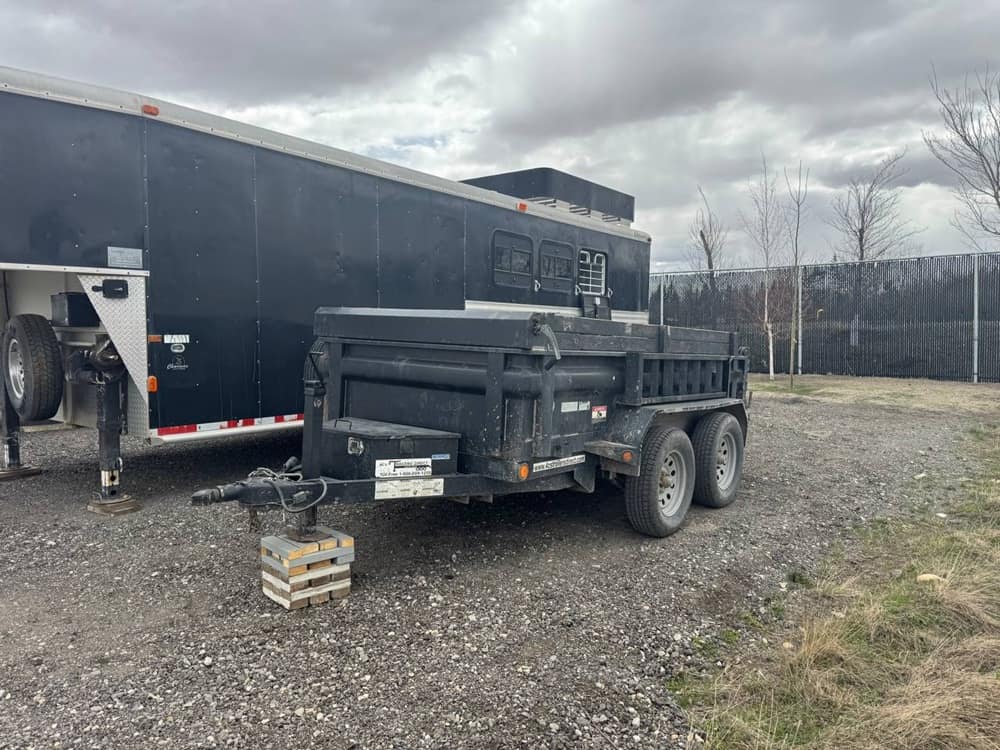
When the main cargo consists of soil, gravel, mulch, sod, or yard waste, the advantage of Dump Trailers lies in their unloading method. A dump trailer for landscaping is equipped with a hydraulic mechanism that lifts the body and significantly simplifies dumping.
For larger-scale tasks, the best dump trailer for landscaping is determined not only by the body volume. You need to check the GVWR, the trailer’s curb weight, and the allowable payload capacity of the specific model. The same body volume can correspond to different specifications.
Step 2: Choosing the Best Size Trailer for Landscaping
Size is determined not only by the amount of equipment. You must consider its length and width, number of units, tool space, loading method, and total setup weight. Landscape trailer sizes that work well for one crew may be inconvenient for another.
There is also a practical limitation: the trailer must match the capabilities of the tow vehicle. Even empty space in the body makes no sense if the actual weight of the trailer with cargo exceeds allowable limits.
Therefore, the best size trailer for landscaping is the size that covers real needs without excess length and weight.
Popular Landscape Trailer Sizes (Single Axle vs. Tandem Axle)
A small crew usually has no need to transport an entire fleet at once. If the core set consists of one or two mowers, trimmers, and hand tools, a 6×10 or 6×12 single axle often provides enough space for daily work. Such a trailer does not take up excess space and is easier to maneuver on city streets and near private residential lots.
When equipment increases, the approach to size changes as well. A 7×14 or 7×16 tandem axle leaves more room between equipment units, so you don’t have to move one machine every time to reach another.
However, dimensions alone say nothing about how much a trailer for landscape can carry. Before renting or buying, you must check the GVWR, axle rating, curb weight, and payload capacity, then compare them with the tow vehicle’s towing capacity.
What Is the Best Size Enclosed Trailer for Landscaping Contractors?
An enclosed trailer that is too small becomes inconvenient almost immediately: equipment has to be stacked in multiple rows, part of the tools hidden behind larger gear, and everything moved around just to access them. But extra space is not always justified either, especially if there is simply nothing to fill it with.
The best size enclosed trailer for landscaping should be selected for your actual set of equipment. For a compact setup, 6×12 may be a sufficient format. If multiple mowers, hand tools, and extra gear are transported simultaneously, considering a larger body makes sense.
In enclosed trailer landscaping, you need to leave space for more than just the machinery itself. It is important that rear doors and ramp open properly, equipment can be secured, and necessary tools remain accessible throughout the workday.
Step 3: Practical Landscape Trailer Setup Ideas for Maximum Efficiency
Even a properly sized trailer can be rendered inconvenient if all equipment lies in a single layer. Landscape trailer setup ideas should be evaluated from a simple perspective: what needs to be pulled out first, what is used constantly, and what can be loaded once and left untouched until the end of the day.
Trimmer Racks, Tool Holders, and Lawn Mower Ramp Gates
Vertical storage helps free up floor space for heavy gear. Separate mounts are used for trimmers and blowers, hand tools can be placed along the sides, and mowers can be secured in an area where they do not block access to smaller equipment.
Trailer racks for landscaping are useful if tools need to be quickly taken and returned to place. For a trailer for landscaping equipment, you should provide separate tie-down points, wheel chocks for mower wheels, and convenient access to the ramp gate.
It is practical to leave the front portion of the trailer for smaller items:
- hand tools;
- spare parts;
- cargo securing straps;
- approved fuel containers in an appropriate, secure location.
The goal here is not to fill every single centimeter. If you have to shuffle half the trailer every time just for one extra piece of gear, the organization is already working against the crew.
Calculating Payload Limits for Commercial Gear and Heavy Dirt Loads
Before loading, you must distinguish between four indicators:
- Empty trailer weight – the unladen mass of the trailer.
- Payload – the weight of cargo allowed to be added.
- GVWR – the maximum allowable total weight of the trailer together with cargo.
- Tow vehicle capacity – the towing capabilities of the vehicle for such a setup.
This is especially critical for heavy materials. Soil, gravel, and wet mulch can quickly increase weight even when the body is only partially filled.
Therefore, a small trailer for landscaping does not automatically mean a light load, just as a large body does not give you the right to load it to the brim. For every trip, consider the actual cargo weight, trailer specifications, and towing vehicle capabilities.
Seasonal Landscaping Transport Solutions in Calgary & Southern Alberta
For landscaping companies in Calgary, a trailer is not loaded identically throughout the entire season. Conventionally, the season can be divided into several typical tasks:
- Spring: site prep, lawn restoration, transporting tools and materials.
- Summer: routine maintenance, where quick loading and access to mowers, trimmers, and other equipment are especially important.
- Fall: yard cleanups, removing leaves, sod, and plant waste, where a dump trailer can noticeably simplify work.
Weather conditions also alter operational environments. After rain, an open load comes into contact with water and mud, while sharp temperature swings can affect the condition of floors, tie-downs, and ramp gates. For bulk materials, Alberta secure load requirements must be followed separately; if cargo needs to be covered, a tarp must be firmly secured before moving.
Rent Commercial-Grade Landscaping Trailers with Hetman Rental
When a trailer is not needed permanently or the company needs to shift throughout the season, renting offers greater flexibility in choice. For daily work with lawn mowers, an open platform may be required; for expensive gear, an enclosed body; and for dirt, mulch, or waste, a dump trailer.
At Hetman Rental, you can choose a commercial trailer for a specific task, equipment volume, and load type. By determining the load weight, required body format, and vehicle capabilities in advance, finding the best trailer for landscaping for a specific job becomes much easier.