

[shared_counts]
Payload Limits Explained: When Do You Need a Tandem-Axle Enclosed Trailer Instead of Single-Axle?
Room left around a load doesn’t tell you much about its weight. Take the single vs tandem axle trailer choice: a sofa fills the box, while a smaller load of workshop gear can put you over the limit. Before heading across Calgary, get those weights straight; the tires and brakes have to cope with every pound you’ve loaded.
Understanding Single-Axle Enclosed Trailers: Capacity and Best Use Cases
For a mattress, bed frame and six dining chairs, a second axle may buy you very little. Assuming the load is within the smaller trailer’s allowance, getting into the driveway could be the harder part. A small single usually leaves you less trailer to manoeuvre past parked cars.
Light-duty singles commonly have a GVWR of 2,990–3,500 lb. Those letters mean gross vehicle weight rating: the maximum for the trailer and everything loaded into it. Ask for its empty weight as well. The box itself uses up part of that allowance before you put so much as a toolbox aboard.
Access can settle the cargo trailer single axle vs tandem question when both models can carry your load. Think about the unloading end of the trip:
- Will the trailer fit beside the house?
- Is there room to lower the ramp?
- Can you pull out again without a difficult turn?
Why Choose a Tandem-Axle Enclosed Trailer for Heavy Loads
Workshop gear is another matter. A compressor, wheeled cabinet and boxes of fittings don’t look like much beside a sofa, but their weight soon adds up. A tandem axle enclosed trailer is worth considering here; 7,000 lb GVWR is a common rating for this class, though it isn’t universal.
What you gain in the tandem vs single axle trailer upgrade should be a higher-rated payload. The wheel load is shared across two axles, usually with four tires. Out on the highway, that arrangement generally feels more settled over bumps when the load is right. You still have the same job at the wheel: leave room to stop and drive for the conditions.
Perhaps you’ve used a tandem axle utility trailer for yard work and know roughly what it will carry. Set that figure aside when hiring an enclosed one. You’ve added a roof, walls and doors to the empty weight, so ask for the cargo allowance of the actual unit you’re taking.
Size Breakdown: From 5×10 to 7×14 Cargo Trailers and Axle Selection
There isn’t a magic length where every trailer suddenly needs two axles. Look at two 6×12 listings and you may find a single in one and a tandem in the other. They’re both nominally six feet wide and twelve feet long, but that’s about all those dimensions tell you.
- 5×10: Usually a small single. Before choosing a 5×10 tandem axle enclosed trailer, compare its payload with the single-axle option. The extra running gear adds weight of its own.
- 6×10: Often single axle too. With a 6×10 tandem axle enclosed trailer, cargo weight is the reason to step up; you haven’t gained floor length.
- 6×12: Both layouts exist. The appeal of a 6×12 enclosed trailer tandem axle setup is keeping the body fairly short while getting a higher payload, where the model’s rating permits it.
- 7×12: Seven feet sounds generous until you account for a door frame. With a 7×12 tandem axle enclosed trailer, measure the rear opening first, particularly for a wide machine.
- 6×14: The awkward bit with a 6×14 tandem axle enclosed trailer can be finding somewhere for one long, heavy item. On paper it fits; in practice its weight may leave you with very few sensible loading positions.
- 7×14: Commonly tandem. There is more room for a household move, but filling it with dense cargo can still take you over its limit.
Our Enclosed trailer catalogue includes a 6×12 single axle rated at 3,500 lb GVWR and a 7×14 tandem rated at 7,000 lb GVWR.
Weight Distribution Diagram: How Axles Manage Load Balance
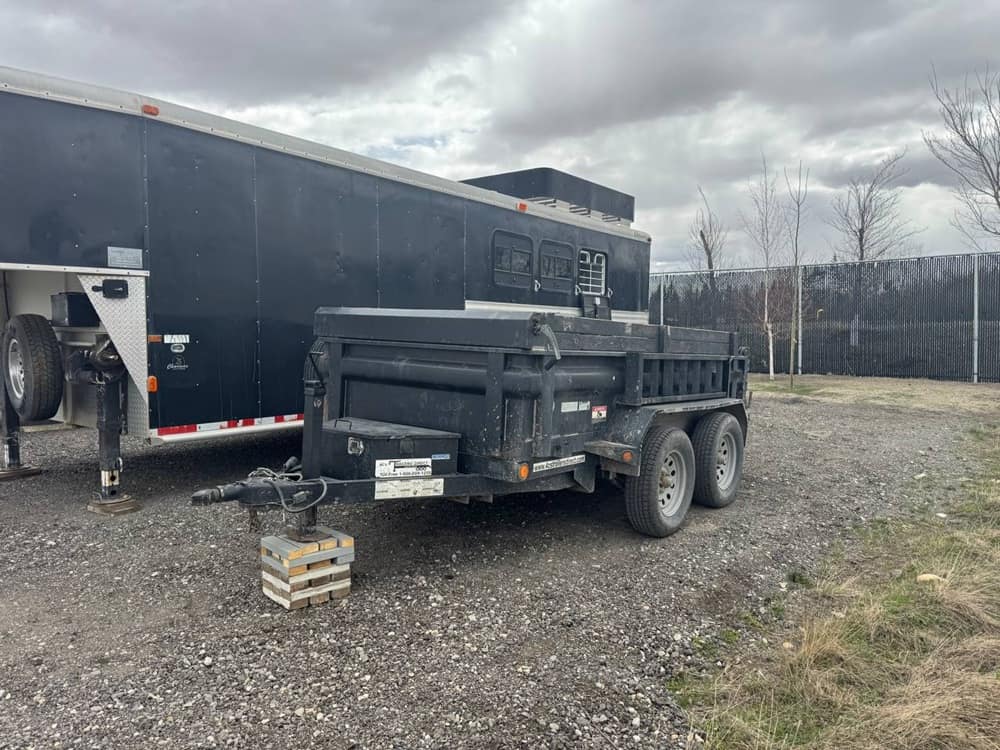
On a loading sketch, mark the hitch first and the axle group underneath the box. Try placing your heaviest crate in a few positions. Up against the nose, more of its weight presses down on the hitch. Pull it back towards the doors and the hitch takes less. That is the relationship a weight distribution diagram needs to show.
With ordinary cargo trailers on a ball hitch, the usual guideline puts 10–15% of the loaded weight on the tongue. Your trailer’s manual is the place to confirm that figure. Take a tandem weighing 4,000 lb with its cargo aboard. If 12% of that weight sits on the hitch, that works out to 480 lb. The axles share the remaining 3,520 lb.
This is where the single vs tandem axle utility trailer argument can go astray. Having four tires doesn’t automatically halve the hitch load. The axles share the weight beneath the body. A heavy cabinet beside the rear doors is easy to reach when unloading. That position, however, can leave too little weight on the hitch and make sway more likely. Keep heavier pieces on the floor, with the weight balanced between the left and right sides. Strap them to rated anchors, then check the hitch and axle loads on a scale.
The spread axle trailer vs tandem question concerns the distance from one axle to the other. A spread layout places them farther apart; you can still be looking at two axles in either case. A bigger gap between them isn’t a higher weight rating.
Key Factors: Payload Limits, GVWR, and Tow Vehicle Compatibility
There is a bit of subtraction to do before loading. Take a rental marked 3,500 lb GVWR that weighs 1,200 lb with nothing loaded. You’ve got 2,300 lb left to work with. Your dolly and straps come out of that as well. A 2,600 lb machine won’t become a suitable load just because there’s space around it.
Then look at the tow vehicle. Its advertised towing capacity is only one of the numbers you need:
- Trailer GVWR and axle limits: Stay within both, as well as tire ratings. GAWR means gross axle weight rating.
- Vehicle payload: Allow for everyone riding along, tools in the vehicle, hitch equipment and trailer tongue weight. Check its GVWR and rear axle rating too.
- Combined weight: In the handbook, find GCWR (gross combined weight rating). This puts a ceiling on what the whole loaded rig can weigh.
- Hitch equipment: Don’t stop at the receiver. The ball mount, ball and coupler have their own ratings; the lowest applicable one is the limit to use. Match the ball size as well.
Alberta’s Vehicle Equipment Regulation, section 56, covers trailer brakes and breakaway systems, with exemptions depending on the trailer and towing vehicle. Confirm the requirements for your combination before pickup. Electric trailer brakes also need a compatible, working controller; having a seven-pin socket isn’t enough on its own.
Making the Right Choice for Your Hauling Project
For a light move, a single may give you all the room and capacity you need. Dense equipment is where a higher-rated tandem earns its place, provided the tow vehicle is up to the job. If the weights are uncertain, get them measured before loading day.
Can I rent a 7×14 tandem axle enclosed trailer near me and tow it with my SUV? That’s something we can work through at Hetman Rental in Calgary. Take a look through the catalogue, then tell us what you’re moving and what you drive. With the cargo dimensions and weight to hand, we can help you choose from the available models.
