[shared_counts]
Trailer Towing 101: Essential Safety Rules, Weight Limits, and Hitching Guide for Beginners
Quick Towing Safety Checklist
- Weight and Payload: The loaded trailer must be within the vehicle’s allowable weight limits.
- Load Distribution: The heaviest items should be closest to the trailer axle. Avoid overloading the rear section.
- Compatibility: The hitch ball must match the trailer coupler.
- Securing: After coupling, all that remains is to check the latch, pin, and safety chains.
- Lighting: The 7-pin connector is plugged in – now check the brake lights, turn signals, and running lights.
- Inspection: Tires, lug nuts, brakes, and hitch coupler are best inspected before departure.
- Driving: A trailer alters braking distance and cornering behavior, so leave extra space while driving.
- Sway: If the trailer starts to sway, do not brake sharply. Release the gas pedal and let the speed drop.
Preparing for your first trip with a trailer requires attention to detail, as the coupling and inspection process itself may seem confusing. In practice, everything is resolved through a clear sequence of actions: if you know what to check and how to do it before heading out, your first towing experience will be calm, safe, and completely under your control.
Understanding Towing Capacity and Weight Limits
When moving, you want to immediately understand which trailer will be convenient for your belongings and will not turn out to be too small on the road. Practical advice on How Choosing the right trailer for moving will help you decide on the trailer type and size. After that, you should move to the main constraint – your vehicle’s capabilities, since they dictate how much weight you can safely tow.
- Towing capacity – the maximum weight of a trailer that a vehicle can tow.
- Payload capacity – the allowable additional load on the vehicle itself, including passengers, cargo, and tongue weight.
- Gross vehicle weight rating (GVWR) – the maximum allowable total weight of the trailer along with all its cargo.
Deciphering Towing Capacity, Payload, and GVWR
First, check two baseline parameters: your vehicle’s towing capacity in the manual and the trailer’s GVWR on its information VIN plate. After that, calculate the weight of the empty trailer, the cargo, as well as the weight of the passengers and luggage in the vehicle.
A simple calculation: a trailer with a GVWR of 3500 kg is not an automatic road clearance for any vehicle. Suppose the trailer’s empty weight is 1200 kg, and 1500 kg of cargo is loaded on top. The actual weight reaches 2700 kg, and this is what is compared against your tow vehicle’s towing capacity. It is equally important to monitor vertical load and know how to calculate tongue weight.
What Is the Rule of Thumb for Towing Capacity?
Wise practice suggests sticking to a simple rule of thumb for towing capacity: limiting the actual weight of the trailer to approximately 80% of what the vehicle is factory-rated to pull is recommended. For example, if the limit is 3000 kg, you leave yourself a comfortable margin of about 600 kg. On the road, this always comes in handy – especially when there are passengers and luggage in the vehicle, and you have to tackle steep climbs, drive against the wind, or navigate slow city traffic. Of course, this is merely practical advice rather than a provincial statutory requirement in Alberta, and it does not take precedence over manufacturer limits. If your vehicle owner’s manual specifies a lower weight limit, that remains the governing rule.
How to Calculate Tongue Weight for Optimal Trailer Balance
As a rule of thumb, 10-15% of the total loaded trailer weight is taken, which means roughly 200–300 kg for every 2000 kg of weight. Trailer tongue weight calculation helps determine the actual load placed on the hitch mechanism. Understanding how to calculate tongue weight on a trailer is made easier with a straightforward sequence: first, determine the total weight of the trailer, and then separately measure the hitch load using a specialized tongue weight scale or appropriate equipment.
Step-by-Step Hitching Guide: Securing Your Load
To avoid wasting extra time figuring things out at the tow hitch, keep a clear, standard operating sequence:
- Coupler: Connect the vehicle and trailer by positioning the coupler directly over the hitch ball.
- Latch: Engage the latch to secure a tight connection with the ball.
- Pin: Insert the safety pin into its designated slot so the latch cannot accidentally open.
- Chains: Securely attach the safety chains to the vehicle’s frame.
- Wiring: Connect the trailer plug and verify the operation of signal lights.
- Brake Controller Check: Before heading out, ensure the status indicator light on your electric brake controller is glowing green.
Choosing the Correct Ball Size (2″ vs 2-5/16″) and Mount
The ball size must match the trailer coupler. If it is designed for 2 inches, a compatible 2-inch ball is required; for other hitches, a 2-5/16 inch ball may be used. You should consider not only the diameter, but also the load capacity rating of the ball itself and the ball mount.
When choosing between a 2-5/16 ball hitch vs 2 inch, it is crucial to consider the specs of the entire hitch assembly and the actual weight of the trailer. The ball, mount, and coupler must all be rated for the corresponding weight load.
Crossing Safety Chains and Understanding the Trailer Plug 7-Pin Wiring Diagram
Safety chains are attached to designated points on the tow vehicle. Underneath the tongue, they are typically crossed: if the trailer detaches from the ball, the chains will catch the tongue and prevent it from dropping onto the road. This is precisely what a proper safety chains crossing setup looks like.
A standard 7-pin connector serves as the single connection hub for trailer lighting and electric brakes. If you suddenly get confused by the wires, a located trailer plug 7 pin wiring diagram will help you figure it out, though it is always best to double-check the contacts with a circuit tester to avoid unpleasant surprises on the road.
Setting Up Braking Systems and Controls Before You Drive
If you are towing a trailer in Alberta with an actual gross weight exceeding 910 kg, it must automatically be equipped with functioning service brakes. Before your first trip, it is worth knowing how to set up electric brake controller systems and ensuring that its settings match your specific trailer and load.
How to Set Up an Electric Brake Controller in Your Tow Vehicle
The electric trailer brake controller setup procedure is best performed at low speeds in an empty parking lot. First, verify that the on-board computer detects the trailer, and set the baseline gain according to the instructions:
- Perform a smooth brake application at low speed and listen to how the trailer responds.
- Is the response too weak? Gradually increase the power gain setting on the controller.
- Is the trailer nose-diving and braking sharply on its own? Decrease the gain setting.
- Test the manual override separately without touching the vehicle’s brake pedal.
- Ensure the entire combination now comes to a smooth, balanced stop.
The ultimate goal is to bring both the vehicle and the cargo to a coordinated stop, rather than relying solely on the trailer brakes to stop the tow rig.
Pre-Drive Checklist: Tire PSI, Lug Nuts, and Signal Lights
A quick pre-trip inspection takes only a few minutes, but guarantees your journey will run smoothly without surprises. Focus on these fundamental items:
- Tire Pressure – check both the tow vehicle and the trailer.
- Tread Condition – ensure there are no deep cuts or uneven wear patterns.
- Lug Nut Torque – verify that all wheel nuts are securely tightened.
- Lighting Systems – check the operation of brake lights, turn signals, and running lights.
- Trailer Braking System – confirm electric brake operation, if equipped.
- Road Test – drive forward briefly at low speed, evaluating the feel and response of the connection.
It is better to spend a minute in the parking area than to troubleshoot mechanical issues on the side of the road.
Defensive Driving Techniques When Towing in Calgary & Southern Alberta
An extended and heavy vehicle combination requires a completely different driving style: brake earlier and execute all maneuvers as smoothly as possible. On Calgary streets, maintaining a safe trailing distance and leaving ample space for maneuvers is extremely important. For first-time trailer towers, practical beginner trailer towing tips Calgary will help – smooth acceleration, anticipating traffic ahead, and gentle steering inputs. Additionally, remember to verify your Class 5 license towing limits Alberta to ensure your combination complies with local regulations.
Managing Stopping Distances and Preventing Highway Trailer Sway
Faced with a trailer that has started to sway due to poor weight distribution or wind gusts? Avoid sudden movements. If the trailer begins to sway, do not attempt to jerk the steering wheel to straighten it out. Smoothly release the gas pedal, do not step hard on the tow vehicle’s brake pedal, and manually engage the trailer brakes using the controller. Once your speed drops and stability returns, continue on your way. This step-by-step approach forms the foundation of trailer sway control Alberta highways.
Turning Radius, Wide Turns, and Backing Up Tips for Beginners
Remember that a trailer always cuts corners toward the inside – leave extra clearance and do not rush to turn the steering wheel when entering a turn. When backing up, aim to act smoothly by making gentle corrections and constantly monitoring both side mirrors. Mastering a backing up trailer technique is best done in an open parking lot, where there is room for error and time to get used to the trailer’s reactions.
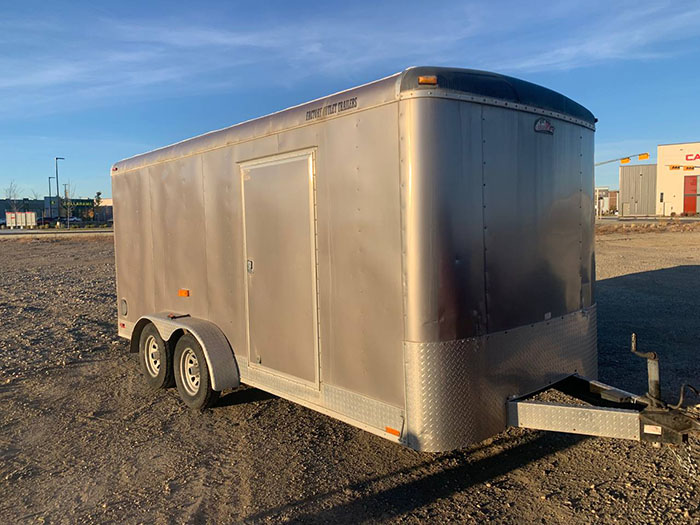
Rent Safety-Checked, Commercial-Grade Trailers with Hetman Rental
Hetman Rental offers commercial-grade trailers for all types of haulage: equipment, construction materials, or household moves. We personally inspect every unit prior to rental and advise on vehicle compatibility. We are always ready to guide beginners on how to properly connect all components, perform an inspection, and maintain control of the combination on the move. Choose Hetman Rental and reserve your trailer for the day you need it.