[shared_counts]
How to Calculate Trailer Load Capacity Safely: A Complete Guide
“It’ll hold” — a phrase that usually marks the beginning of the most expensive mistakes on the road. When it comes to loading a trailer, intuition is a poor advisor, because a cracked spring or “fading” brakes somewhere on the highway cost significantly more than five minutes of calculations. All these confusing terms like GVWR or GTW are not actually there to puzzle you, but to prevent your vehicle from turning into a pile of scrap metal under the weight of an overload. We have compiled this guide so you clearly understand what is gross vehicle weight rating, how it is decoded on a trailer, and exactly how much weight you can pull with your car.
Understanding the Basics: What is Gross Vehicle Weight Rating (GVWR)?
To explain what is the gross vehicle weight rating without unnecessary technical jargon, it is the total mass of the loaded trailer, and not a single extra kilogram can be loaded. This is the technical limit, which includes the weight of the trailer itself, the cargo, and all additional equipment you have attached to it.
The manufacturer calculates the GVWR based on the weakest link: axle strength, braking system capabilities, and frame durability. Authorities and insurance companies also rely on this indicator — exceeding it can have far-reaching consequences in the event of an insurance claim.
GTW vs. GVWR: What is the Gross Weight of a Trailer?
Now comes an interesting point, as drivers often confuse the data on the trailer tongue with the weight of what is actually being carried in the bed. If you are looking for the answer to the question, what is the gross weight of a trailer, remember the acronym GTW (Gross Trailer Weight). This is the actual weight of your trailer along with all the goods you have loaded into it right now.
The difference between these concepts is easy to explain on your fingers:
- GVWR is the maximum allowable figure specified by the manufacturer, a limit that cannot be crossed;
- GTW is the reality, the figure that the scales on the highway will show.
Imagine you are pulling into a weigh station. What appears on the display is your Gross Trailer Weight. This includes everything: the trailer frame, spare tire, tarps, and every kilogram of your cargo.
The main safety rule is simple: your actual GTW should never be greater than the factory GVWR. If the scales show less than the limit — well done, you can go. If it’s even one kilogram more — you are overloaded, and it doesn’t matter that “it’s only two blocks away” or “the trailer doesn’t look like it’s sagging yet”.
For those who rent equipment, this is a critical moment. The lessor gives you a trailer with an already established “ceiling” (GVWR) that cannot be changed. But how close you get to this limit or whether you cross it is your area of responsibility. Understanding this difference helps not just to avoid fines, but simply to preserve the suspension of the car that is forced to pull it all.
Step-by-Step: How to Calculate Trailer Payload
For those who want to figure out how to calculate trailer payload, you only need two values: the total limit (GVWR) and the actual weight of the trailer itself (Curb Weight). The formula is as simple as possible, but it is the one that saves you from trouble:
Payload = GVWR — Curb Weight (Payload = Max Weight — Empty Trailer Weight)
Let’s use an example: suppose you have a trailer with a GVWR of 2700 kg. By itself, it weighs 450 kg. We have: 2700 – 450 = 2250 kg. This is your real “ceiling” — this is the maximum amount of cargo you can load.
It is important to remember: own weight does not mean an empty frame. It includes all sides, tarps, ramps, and the spare wheel — everything you will be carrying. Add another metal toolbox — and that will also take away available payload kilograms.
Going beyond the limits is critically dangerous, because in Alberta, where rain or snow can turn the road into a skating rink in minutes, there is a significant risk that the trailer will pull the car into a ditch on the very first descent.
Know Your Limits: Utility Trailer Weight Limit
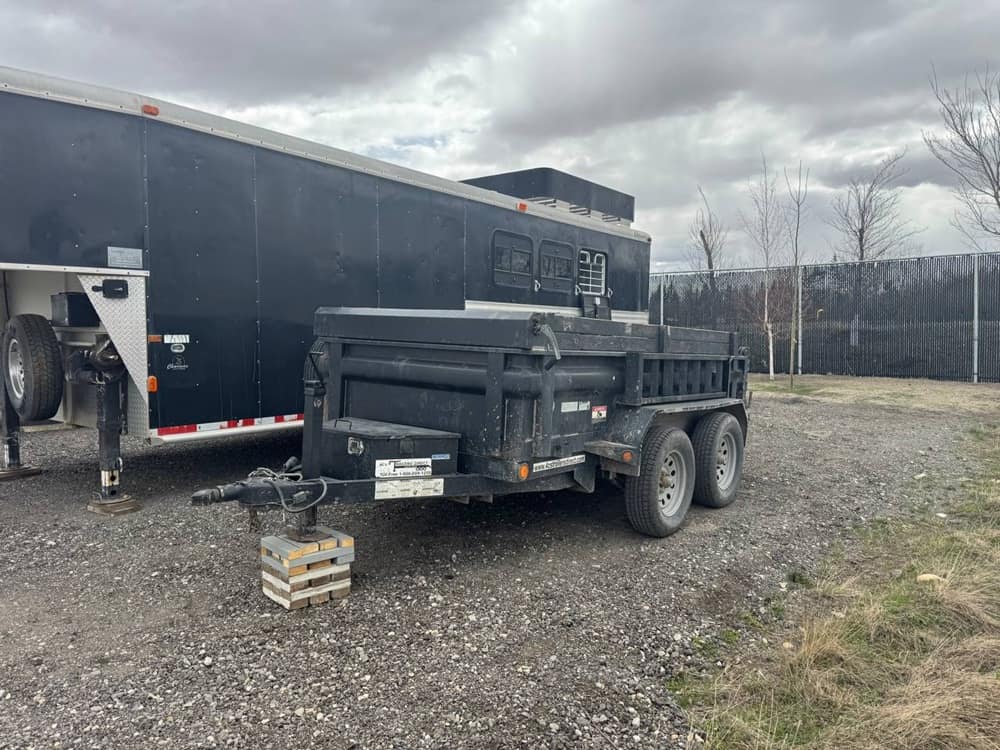
Two visually similar trailers can have a different utility trailer weight limit — it directly depends on the axles and frame strength.
In rentals, two types are most common:
- Single Axle: Usually, these are trailers with a gross weight (GVWR) of up to 1500–1800 kg. They are easier to maneuver, but all the weight presses on one pair of wheels, so any mistake in cargo layout immediately hits the handling.
- Tandem (Two Axles): Here, the limits increase to 2700–4500 kg. Two axles distribute pressure better and prevent the trailer from excessively swaying the rear of the car. This is the standard for transporting equipment or heavy construction materials, where stability is more important than maneuverability.
Remember the “weakest link” rule: if your hitch is rated for 2 tons and the trailer for 3, your real limit stops at the 2-ton mark. Always focus on the lowest value among all components of the vehicle combination.
Practical advice: check the VIN plate or the sticker on the tongue or frame of the trailer. This is the only source of official data on GVWR and axle loads that has legal force.
Safe Loading Practices and Weight Distribution
The numbers on the scale are just numbers, but the actual gross trailer weight in motion depends on balance. The 60/40 rule exists for a reason: weight in the front stabilizes the hitch, while an overloaded rear is guaranteed to lift the front wheels of your car. Distribute the load so that 60% presses on the front part of the trailer; otherwise, in the first turn, you will feel who is driving whom.
Such distribution creates the correct pressure on the coupling device. If you load the “tail”, the trailer will start to sway the car, and at speed, you will get a pendulum effect. Place heavy items as low as possible and strictly in the center — no leaning to one side.
For Calgary, this is a matter of survival on the road. On busy highways like Deerfoot Trail or Stoney Trail, where the flow moves at high speed and the prairie wind adds excitement, any mistake with weight distribution becomes fatal. If your trailer starts to “dance” during a lane change, it will be almost impossible to straighten it out. Remember: exceeding the trailer load capacity or a shifted center of gravity is the shortest path to an accident in Alberta’s dense traffic. Follow the limits and load wisely so the trip ends with unloading, not calling a tow truck.
Renting the Right Trailer in Calgary
No one wants to end up on the shoulder of Stoney Trail with a cracked frame or explaining to the police why the trailer weight clearly exceeds the figures in the documents. To avoid such surprises, it is worth turning to places where technical conditions and limits are taken care of in advance. If you need a trailer rental in Calgary, Hetman Rental is the place where we take all the paperwork and technical routine upon ourselves.
We carefully analyze each client’s request: what exactly you are going to carry and what you plan to pull it with. Knowledge of the technical nuances of your vehicle — from rear axle load to braking power — allows us to offer a model that doesn’t just “fit” but will be perfectly balanced on the road.
Contact us to pick a trailer that matches the capabilities of your tow vehicle. The Hetman Rental team will help you find the optimal option for your tasks so you can safely deliver your cargo to any point in Alberta.